
5 Days Marangu Route: The Ultimate Itinerary, Success Rate & Safety Guide
Booking an expedition to the Roof of Africa requires balancing your vacation time with the strict physiological demands of high altitude. If you are researching the 5 days Marangu route, you are likely drawn to the “Coca-Cola” route’s famous dormitory-style hut accommodations and its reputation as the most accessible path up the mountain.
The short answer is that the 5 day Marangu route is the oldest and only trail on Mount Kilimanjaro that offers permanent, solar-powered sleeping huts rather than tents. However, medical and mountaineering experts strongly caution against this specific 5-day timeline. While the trail is mechanically gradual, the rapid 5-day ascent provides severely limited time for altitude acclimatization, resulting in a lower summit success rate (ranging from 42% to 75%) compared to longer itineraries.
This comprehensive guide breaks down the exact 5 days kilimanjaro marangu route itinerary, transparently outlines the physiological risks, details the costs, and explains why upgrading to a 6-day trek is the smartest decision you can make for your expedition.
The 5 days Marangu route is the only Kilimanjaro trail offering permanent dormitory-style hut accommodations. While physically gradual, this 5 day Marangu route itinerary has a lower summit success rate (42%–75%) due to a rapid ascent and lack of rest days. Experts strongly recommend upgrading to a 6-day trek to add a crucial acclimatization day at Horombo Hut, drastically improving your safety and summit chances.
The Reality of the Marangu Route 5 Days Trek: The “Easiest Route” Myth
When evaluating a marangu route 5 days trek, it is vital to separate physical trail difficulty from physiological adaptation.
- The Mechanical Advantage: The trail is often labeled the “easiest” route because it features a gradual path, steady inclines, and no technical rock climbing.
- The Physiological Deficit: A 5-day schedule forces your body to ascend from 1,860m to 5,895m in just 72 hours. This violates the golden rule of high-altitude mountaineering: “climb high, sleep low.”
- The Success Rate Drop: Because of this accelerated schedule, the 5 day marangu route success rate is notoriously lower than longer routes—often cited between 42% and 75% depending on the operator and climber fitness. Nearly half of all climbers on the 5-day itinerary are forced to turn back due to Acute Mountain Sickness (AMS).
5 Days Marangu Route: Day-by-Day Itinerary
Below is the definitive breakdown of the 5 day marangu route kilimanjaro trek:
Day | Route Segment | Elevation Profile | Distance / Time | Ecological Zone & Highlights |
|---|---|---|---|---|
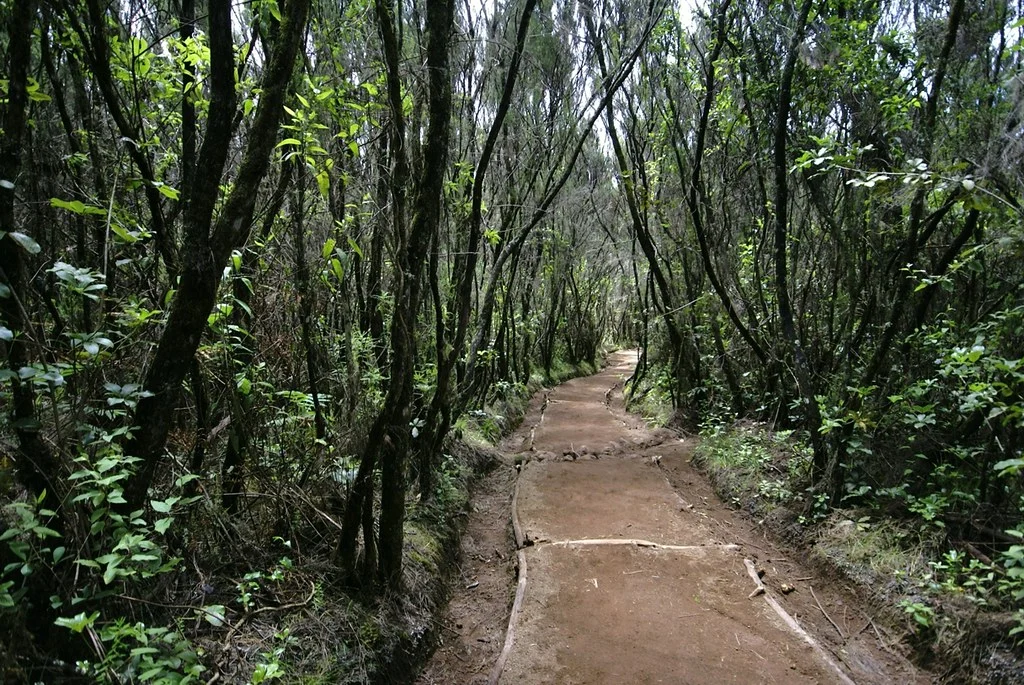
Day 1 | Marangu Gate to Mandara Huts | 1,860m → 2,740m (8,990 ft) | ~7 km / 4–5 Hours | Lush Rainforest. Towering trees, lush canopy, and potential Colobus monkey sightings. |
Day 2 | Mandara Huts to Horombo Huts | 2,740m → 3,690m (12,100 ft) | ~11 km / 6–8 Hours | Heathland & Moorland. Vegetation thins; first clear views of Mawenzi Peak. |
Day 3 | Horombo Huts to Kibo Huts | 3,690m → 4,695m (15,400 ft) | ~10 km / 6–8 Hours | Alpine Desert. Crossing the barren, lunar-like saddle between Kibo and Mawenzi. |
Day 4 | Kibo Huts to Uhuru Peak to Horombo | 4,695m → 5,895m → 3,690m | ~18 km / 10–15 Hours | Summit & Descent. Midnight start, grueling scree ascent, summit, and long descent. |
Day 5 | Horombo Huts to Marangu Gate | 3,690m → 1,860m (6,100 ft) | ~18 km / 5–7 Hours | Descent. Rapid drop back into the rainforest, certificate ceremony, and transfer. |
Accommodation: The Hut Experience
The defining feature of the 5 days kilimanjaro marangu route is the accommodation. You will sleep in bunkhouse-style wooden huts (Mandara, Horombo, and Kibo) equipped with shared sleeping rooms, basic mattresses, and communal dining halls.
Note: While the huts provide a roof over your head, they are unheated. You must still bring a sleeping bag rated to at least -15°C (5°F) and a thermal liner for warmth and hygiene.
5 Day Marangu Route Cost & Inclusions
Because the 5 day marangu route requires fewer days of crew wages and park fees, it is often marketed as the “budget” option.
Cost Category | Estimated Range (USD) | What It Covers |
|---|---|---|
Base Package Price | $1,450 – $2,800+ | Varies heavily by operator ethics, group size, and private vs. shared departures. |
Park & Hut Fees (Included) | ~$800 – $1,000 | Mandatory KINAPA conservation, rescue, and dormitory hut fees. |
Crew Tips (Excluded) | $250 – $450 | Mandatory gratuities distributed to your guide, cook, and porters on the final morning. |
Travel Insurance (Excluded) | $100 – $350 | Mandatory. Must cover high-altitude medical evacuation up to 6,000 meters. |
Why Experts Recommend 6 Days Instead
If your schedule allows, upgrading your marangu route 5 days trek to a 6-day itinerary is the single best investment you can make.
By adding just one extra day, you spend a full rest day at Horombo Hut (3,690m). You hike up to the Zebra Rocks (4,020m) and return to sleep at the same altitude. This “climb high, sleep low” protocol triggers your kidneys to produce erythropoietin (EPO), stimulating red blood cell production and drastically reducing AMS symptoms. This single rest day pushes the Marangu success rate from ~50% up to 85%+.
The Critical Role of Expert Guidance
Navigating the severe physiological risks of a rapid 5-day ascent requires uncompromising professional oversight. You cannot “tough out” hypoxia.
For comprehensive pre-trip planning, realistic itinerary assessments, and transparent operator vetting, consulting a trusted Mount Kilimanjaro Guide is the essential first step. They will help you understand why ethical operators often refuse to book the 5-day itinerary, and will guide you toward safer, higher-success alternatives.
Furthermore, having an experienced kilimanjaro local guide is the most critical safety investment you can make. If you are committed to the hut-based Marangu route, a top-tier, Wilderness First Responder (WFR) certified guide will monitor your blood oxygen saturation twice daily, manage your hydration, and make the life-saving call to initiate a descent if severe AMS symptoms appear during the rapid 5-day push.
Frequently Asked Questions (FAQ)
How hard is the 5 day Marangu route?
Mechanically, the 5 day Marangu route is considered moderate because it features a gradual incline and no technical climbing. Physiologically, however, it is very hard due to the rapid ascent, which leaves almost no time for your body to adapt to the thinning air, making summit night exceptionally grueling.
What is the success rate of the 5 days Marangu route?
The summit success rate for the 5 days Marangu route is notoriously lower than longer routes, typically ranging between 42% and 75%. This is directly attributed to the lack of an acclimatization day at Horombo Hut, which forces many climbers to turn back due to altitude sickness.
Do you sleep in tents on the Marangu route 5 days trek?
No. The Marangu route 5 days trek is the only trail on the mountain that features permanent, dormitory-style wooden huts (Mandara, Horombo, and Kibo Huts) equipped with basic bunk beds and communal dining halls, eliminating the need for camping tents.
How much does a 5 day Marangu route Kilimanjaro trek cost?
A 5 day Marangu route Kilimanjaro trek typically costs between $1,450 and $2,800+ USD per person. This includes park fees, hut accommodations, guide/porter wages, and meals, but excludes flights, visas, high-altitude travel insurance, and crew tips ($250–$450).
