
Lemosho Route Itinerary: The Ultimate 8-Day Day-by-Day Guide
Choosing the right path and pacing is the single most important decision you will make for your expedition. If you are researching the lemosho route itinerary, you need a precise, day-by-day breakdown of the distances, elevations, and habitats you will traverse on your way to the Roof of Africa.
The short answer is that the standard lemosho route 8 days itinerary is widely considered the gold standard for climbing Mount Kilimanjaro. Starting at Londorossi Gate (2,385m), it gradually ascends through the rainforest, across the scenic Shira Plateau, and up to Uhuru Peak (5,895m) over 7 days of trekking, followed by a descent day. This extended lemosho route itinerary 8 days format provides the optimal “climb high, sleep low” acclimatization profile, pushing summit success rates to 90–95%.
This comprehensive guide breaks down the exact 8 day lemosho route itinerary, compares it to the 7-day option, and provides expert tips to ensure your expedition is safe, successful, and unforgettable.
What is the 8-day Lemosho route itinerary? The 8 day lemosho route itinerary is a 7-day ascent and 1-day descent trek starting at Londorossi Gate (2,385m). Key milestones include Shira Camp (Day 2), a “climb high, sleep low” acclimatization day at Lava Tower (Day 4), scaling the Barranco Wall (Day 5), and a midnight summit push to Uhuru Peak (5,895m) on Day 7, followed by a descent via the Mweka trail on Day 8. It is renowned for its high success rate and scenic diversity.
The 8-Day Lemosho Route Itinerary: Day-by-Day Breakdown
Below is the definitive, day-by-day breakdown of the lemosho route itinerary 8 days:
Day | Route Segment | Distance | Hiking Time | Altitude (Start → End) | Habitat |
|---|---|---|---|---|---|
Day 1 | Londorossi Gate to Big Tree Camp (Mti Mkubwa) | ~6 km | 3–4 hours | 2,385m → 2,780m | Rainforest |
Day 2 | Big Tree Camp to Shira Camp 1 | ~8 km | 5–6 hours | 2,780m → 3,500m | Moorland |
Day 3 | Shira Camp 1 to Shira Camp 2 / Moir Hut | ~10–14 km | 5–7 hours | 3,500m → 3,900m / 4,200m | Semi-Desert |
Day 4 | Moir Hut to Barranco Camp (via Lava Tower) | ~7–11 km | 6–8 hours | 4,200m → 4,630m → 3,960m | Alpine Desert |
Day 5 | Barranco Camp to Karanga Camp | ~5 km | 4–5 hours | 3,960m → 4,035m | Alpine Desert |
Day 6 | Karanga Camp to Barafu / Kosovo Camp | ~4 km | 3–5 hours | 4,035m → 4,640m / 4,890m | Alpine / Arctic |
Day 7 | Barafu Camp to Uhuru Peak, descend to Mweka/Millennium | ~5km up / 12km down | 7–8h up / 4–6h down | 4,640m → 5,895m → 3,068m / 3,950m | Arctic / Moorland |
Day 8 | Mweka/Millennium Camp to Mweka Gate, return to Moshi | ~10 km | 3–4 hours | 3,068m / 3,950m → 1,640m | Rainforest |
Deep Dive: What to Expect on Your Lemosho Route Itinerary
- Day 1: The Rainforest Beginnings. After registration at Londorossi Gate, you trek gently through an undisturbed montane rainforest. Keep an eye out for black-and-white colobus monkeys and vibrant birdlife.
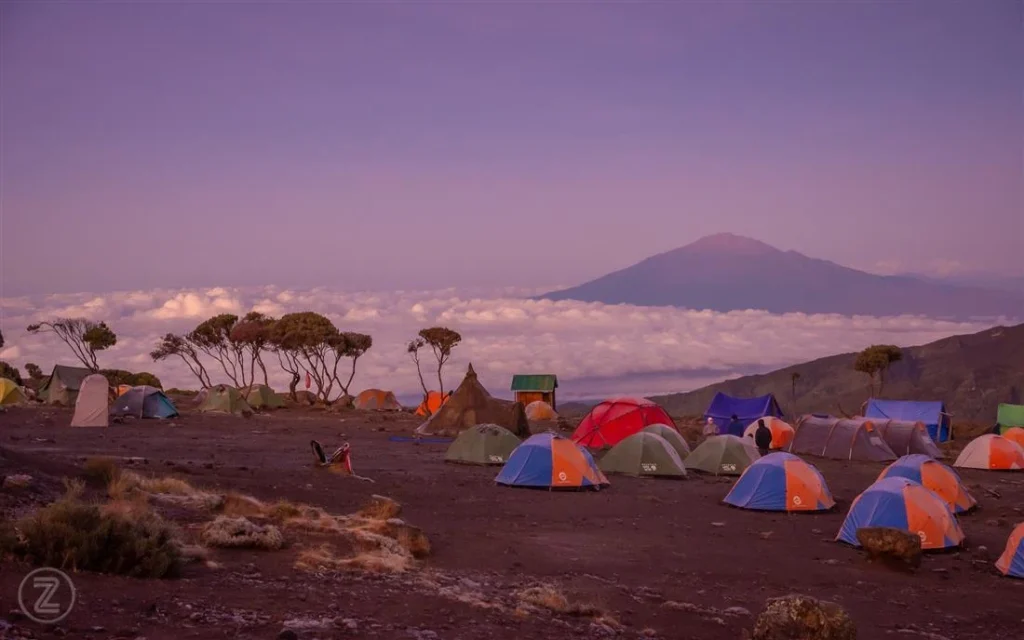
- Day 2: Emerging onto the Shira Plateau. You leave the forest canopy and climb through steep shrub and heather zones, emerging onto the lower edge of the Shira Plateau with your first panoramic views of the Kibo peak.
- Day 3: Crossing the High Plateau. Trek across the broad, rolling Shira Plateau. The air thins, and the landscape transforms into a semi-desert environment featuring unique volcanic rock formations and the iconic Shira Cathedral.
- Day 4: The Critical Acclimatization Day. This is the most important day of the lemosho route itinerary. You ascend to Lava Tower (4,630m) for lunch, exposing your body to extreme altitude to stimulate red blood cell production. You then descend to sleep at the lower, oxygen-rich Barranco Valley (3,960m), perfectly executing the “climb high, sleep low” principle.
- Day 5: Conquering the Barranco Wall. You will scramble up the famous, non-technical Barranco Wall. While visually intimidating, it requires no ropes. Afterward, you traverse rolling ridges beneath the Southern Ice Fields to Karanga Camp.
- Day 6: The Final Base Camp. A short, steady climb through the alpine desert brings you to Barafu (or Kosovo) Base Camp. You will eat an early dinner, check your gear, and rest before the midnight summit attempt.
- Day 7: Summit Day & Descent. Starting around midnight, you hike in the dark to reach Stella Point (5,730m) by sunrise, then push to Uhuru Peak (5,895m). After celebrating, you descend steeply to Millennium or Mweka Camp for a crucial, deep sleep.
- Day 8: The Final Descent. A gentle, 3-to-4-hour walk down through the rainforest to Mweka Gate. Here, you will receive your official summit certificates before transferring back to your hotel in Moshi or Arusha.
8-Day vs. 7-Day Lemosho Route Itinerary: Which is Better?
When planning, you will often see a lemosho route itinerary 7 days option. While it is possible to complete the climb in 7 days, mountaineering experts and historical data overwhelmingly favor the lemosho route 8 days itinerary.
The 7-day option compresses the ascent, often bypassing the crucial acclimatization hike to Moir Hut or rushing the Lava Tower descent. This steeper daily elevation gain significantly increases the risk of Acute Mountain Sickness (AMS) and drops the summit success rate from ~90%+ (on 8 days) to roughly 75% (on 7 days). Investing in the extra day is the single most effective way to guarantee your safety and success.
The Critical Role of Expert Guidance
Executing a multi-day high-altitude expedition requires professional oversight. The mountain environment is unpredictable, and proper pacing is the difference between a triumphant summit and a medical evacuation.
For comprehensive pre-trip planning, transparent itinerary comparisons, and help selecting a schedule that matches your fitness level, consulting a trusted Mount Kilimanjaro Guide is the essential first step. They will help you filter out operators who push dangerous, fast-track itineraries and connect you with reputable teams that prioritize safe, gradual acclimatization.
Furthermore, having an experienced kilimanjaro local guide is the most critical safety investment you can make on the mountain. A top-tier, Wilderness First Responder (WFR) certified guide will intimately monitor your health metrics, enforce the vital “pole pole” (slowly, slowly) pace, and manage your energy output across the grueling daily elevation changes of the Lemosho trail.
*(Note: Unlike the classic Marangu route, which is often marketed as the “easiest” due to hut accommodations, the Lemosho route itinerary provides vastly superior physiological adaptation. The Marangu route’s standard 5-day schedule rushes the ascent, resulting in a notoriously high failure rate compared to the gradual, 8-day Lemosho approach.)*
Frequently Asked Questions (FAQ)
What is the success rate of the 8 day lemosho route itinerary?
The 8 day lemosho route itinerary boasts a summit success rate of 90% to 95%. This is the highest of any route on the mountain, directly attributed to its gradual elevation gain and the critical “climb high, sleep low” acclimatization day at Lava Tower.
How hard is the lemosho route itinerary 7 days compared to 8 days?
The lemosho route itinerary 7 days is significantly harder on the body. It compresses the same elevation gain into fewer days, eliminating vital acclimatization time. This leads to a much higher incidence of altitude sickness and a lower overall success rate.
What is the longest hiking day on the Lemosho route itinerary?
Day 7 is by far the most demanding. It involves a 7-to-8 hour midnight ascent to Uhuru Peak, immediately followed by a 4-to-6 hour steep descent to Mweka or Millennium Camp, totaling 11 to 14 hours of continuous hiking at extreme altitude.
Can I customize the lemosho route 8 days itinerary?
Yes. Many reputable operators allow you to extend the lemosho route 8 days itinerary to 9 days by adding an extra acclimatization day on the Shira Plateau or at Karanga Camp, which is highly recommended for older climbers or those with concerns about altitude.
